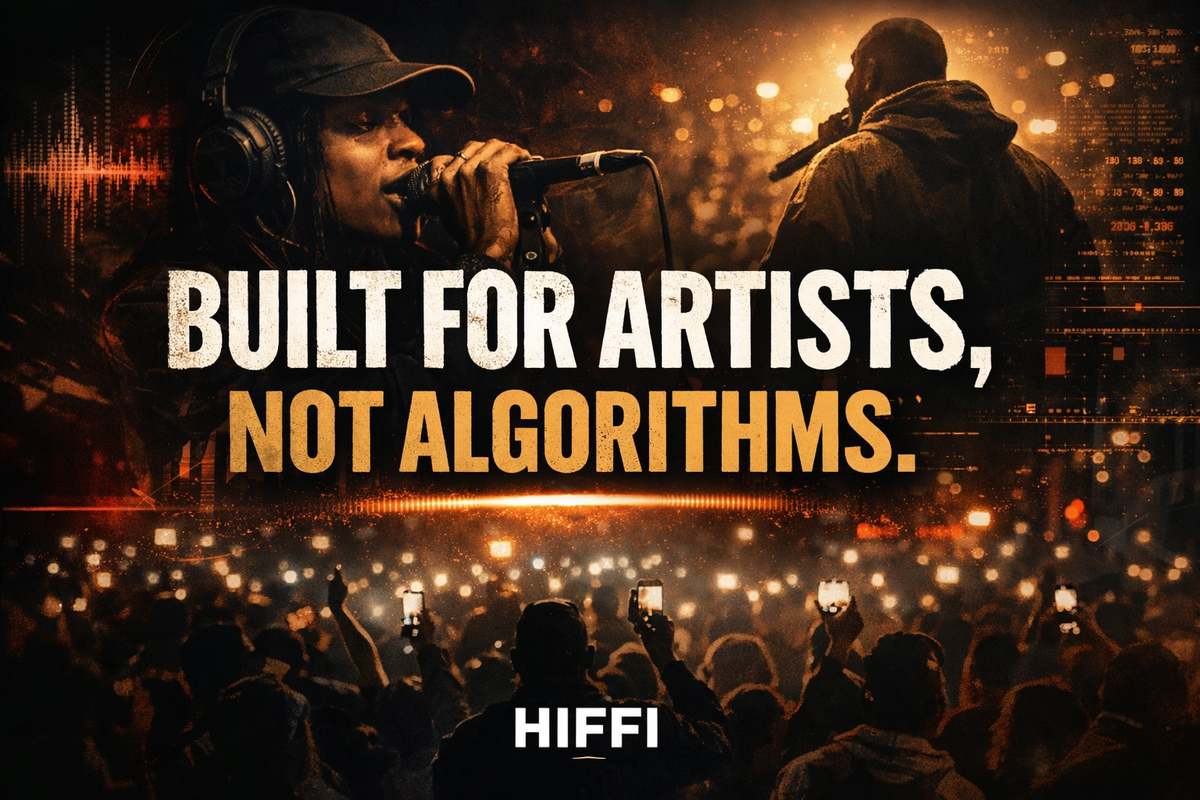
Built for Artists, Not Algorithms.
There was a time when making music meant making moments.
You pressed a CD into someone’s hand.
You handed out burned mixtapes after shows.
You uploaded to DatPiff and waited for word of mouth to ripple outward.
You built your name in rooms before you built it on screens.
Hip-hop was never born inside an algorithm.
It was born in parks.
In basements.
On street corners.
In tension.
In hunger.
In communities that didn’t wait for permission.
And yet today, the fate of an artist’s career can hinge on a recommendation engine.
Not on bars.
Not on presence.
Not on story.
Not on culture.
On metrics.
Streams.
Skip rates.
Completion percentages.
Playlist placement.
Engagement velocity.
The modern music ecosystem tells artists: optimize for the machine.
Make it shorter.
Hook faster.
Cut the intro.
Trend-hop.
Repeat the format.
Feed the feed.
But here’s the uncomfortable truth:
When artists start making music for algorithms, culture starts thinning out.
And when culture thins out, everything becomes disposable.
This is why Hiffi exists.
Because hip-hop deserves platforms built for artists — not algorithms.
The Algorithm Era: Efficiency Over Expression
Algorithms aren’t evil.
They are efficient.
They’re designed to maximize attention, retention, and platform revenue. They optimize for:
- What keeps listeners from skipping
- What increases session time
- What drives ad impressions
- What increases subscription retention
From a business standpoint, that makes sense.
From an artist standpoint, it changes behavior.
When success becomes algorithm-dependent, art becomes data-informed.
Songs become shorter.
Hooks hit sooner.
Verses shrink.
Risks decrease.
Artists start asking:
- Will this intro get skipped?
- Is this beat too slow for playlist placement?
- Should I drop every 4 weeks to stay relevant?
- Should I sound more like what’s trending?
It’s subtle at first.
Then it’s structural.
Then it’s cultural.
The platform begins shaping the art.
And hip-hop was never meant to be shaped by a machine.
It was meant to challenge the system, not be optimized by it.
The Playlist Problem
Playlists have replaced A&Rs.
That sounds empowering — until you look closer.
Today, discovery often happens through:
- Editorial playlists
- Algorithmic recommendations
- “Similar artists” tabs
- Viral social audio trends
That means gatekeeping didn’t disappear.
It just changed form.
Instead of convincing one label executive, you’re trying to satisfy a recommendation engine.
Instead of building a direct audience, you’re chasing placements.
Instead of owning attention, you’re renting visibility.
And here’s the dangerous part:
When your growth depends on someone else’s playlist, you don’t own your audience.
You borrow it.
Borrowed audiences disappear fast.
Owned audiences compound.
Streams Don’t Equal Support
A million streams looks impressive.
But ask yourself:
How many of those listeners know your name?
How many would buy a ticket?
How many would show up to a live stream?
How many would buy merch?
How many would follow you off-platform?
Streams measure passive consumption.
Support measures active connection.
The algorithm optimizes for passive consumption.
Artists need active connection.
There’s a difference between someone hearing your song and someone believing in you.
The industry conflated the two.
We didn’t.
The Independent Shift
Something is changing.
Quietly.
Steadily.
Irreversibly.
Artists are realizing:
- They don’t need permission to release.
- They don’t need a label to reach fans.
- They don’t need to chase playlists to build income.
- They don’t need millions of listeners — they need thousands who care.
The future of hip-hop is not dependent on major label validation.
It’s dependent on direct relationships.
The next wave of artists understands something powerful:
Ownership > exposure.
Control > virality.
Community > reach.
And that’s where the shift happens.
Built for Artists Means…
It means designing a platform around the artist’s needs — not the advertiser’s.
It means asking different questions:
Instead of:
How do we increase session time?
Ask:
How do we increase artist leverage?
Instead of:
How do we reduce skip rates?
Ask:
How do we increase fan loyalty?
Instead of:
How do we maximize streams?
Ask:
How do we maximize sustainable careers?
Being built for artists means:
- Transparent monetization
- Direct fan engagement
- Fair exposure mechanics
- Long-form space
- Live interaction
- Data that empowers, not pressures
It means giving artists tools — not triggers.
Why Live Matters More Than Ever
Streams are quiet.
Live is electric.
When an artist performs live — digitally or physically — something happens that no algorithm can replicate.
Energy transfers.
Moments happen.
Community forms in real time.
Live forces presence.
And presence builds loyalty.
An artist with 2,000 fans who show up live is more powerful than an artist with 200,000 passive listeners.
Live doesn’t optimize for skip rate.
It optimizes for connection.
And connection is what sustains careers.
The Attention Economy vs. The Ownership Economy
We’re transitioning from an attention economy to an ownership economy.
In the attention economy:
- Platforms win.
- Algorithms win.
- Ads win.
Artists fight for scraps of visibility.
In the ownership economy:
- Artists build direct communities.
- Fans invest emotionally and financially.
- Platforms act as infrastructure, not gatekeepers.
The smartest artists aren’t asking:
“How do I go viral?”
They’re asking:
“How do I build 1,000 true supporters?”
Because 1,000 true supporters:
- Buy tickets
- Buy merch
- Show up to streams
- Share organically
- Defend your name
- Stick through experimentation
Algorithms can’t manufacture loyalty.
Only experience can.
Data Without Dignity
Most artist dashboards today show:
- Streams
- Geographic data
- Demographics
- Skip rates
- Save rates
- Completion percentages
What they don’t show:
- Why someone connected
- What line hit hardest
- Who’s showing up repeatedly
- Which fans are super supporters
Data should empower.
Instead, it often creates anxiety.
Artists start obsessing over dips.
Over daily fluctuations.
Over comparison.
When your self-worth becomes tied to a graph, art suffers.
Being built for artists means building data systems that serve growth — not insecurity.
The Myth of Scale
We’ve been taught that scale equals success.
Millions of streams.
Millions of followers.
Millions of views.
But scale without loyalty is fragile.
A small but loyal base can:
- Fund tours
- Crowdfund albums
- Sustain subscriptions
- Drive consistent revenue
A large but passive base disappears when trends shift.
The independent era is about durable careers — not momentary spikes.
It’s about building something that lasts longer than a trending sound.
Hip-Hop Was Always Entrepreneurial
Hip-hop artists were business builders long before Silicon Valley glorified founders.
They:
- Sold CDs out of trunks.
- Built clothing brands.
- Launched record labels.
- Owned masters.
- Controlled distribution.
Ownership was always part of the culture.
The algorithm era diluted that spirit by centralizing power in platforms.
But ownership is returning.
Artists are learning about:
- Masters
- Publishing
- Direct distribution
- Merch economics
- Live monetization
- Community subscriptions
The independent wave is not anti-business.
It’s pro-artist business.
A Platform Should Be Infrastructure, Not Authority
The old model positioned platforms as:
Curators.
Gatekeepers.
Deciders.
The new model positions platforms as:
Infrastructure.
A bridge between artist and fan.
Nothing more.
Nothing less.
A platform built for artists does not:
- Decide what’s worthy.
- Suppress experimentation.
- Prioritize advertiser safety over authenticity.
It enables.
It amplifies.
It facilitates.
It stays out of the way of culture.
Culture Moves Faster Than Code
Algorithms are reactive.
Culture is proactive.
By the time an algorithm detects a trend, the real wave has already moved.
Independent artists don’t wait for algorithmic validation.
They build momentum in rooms.
In group chats.
In live streams.
In communities.
In subcultures.
Platforms should amplify those movements — not attempt to manufacture them.
The Mental Health Cost of Algorithm Dependency
There’s a psychological toll to algorithm dependency.
When visibility is unpredictable:
- Anxiety rises.
- Comparison increases.
- Creative risks decrease.
- Burnout accelerates.
Artists feel pressure to:
- Post constantly.
- Drop frequently.
- Stay visible at all costs.
The machine never sleeps.
But artists need to.
A platform built for artists respects:
- Creative cycles.
- Long-term arcs.
- Depth over frequency.
What the Independent Future Looks Like
Imagine this:
An artist doesn’t measure success by streams alone.
They measure:
- Repeat live attendance.
- Direct fan subscriptions.
- Community engagement.
- Merch velocity.
- Collaborative growth.
Imagine:
Fans discovering artists not through endless autoplay, but through curated cultural ecosystems.
Imagine:
Artists releasing without fear of being buried.
Imagine:
Monetization aligned with value, not volume.
Imagine:
A platform where your identity isn’t flattened into a genre tag.
That’s not a fantasy.
That’s the direction culture is heading.
Built for Artists, Not Algorithms
This isn’t anti-technology.
It’s anti-reduction.
Artists are not metrics.
Culture is not a spreadsheet.
Hip-hop is not background noise.
It’s voice.
It’s rebellion.
It’s entrepreneurship.
It’s storytelling.
It’s survival.
Platforms should respect that.
At Hiffi, the mission is simple:
Create space where artists:
- Own their narrative.
- Build direct audiences.
- Monetize fairly.
- Perform live.
- Grow sustainably.
No chasing invisible code.
No shaping art to satisfy machine preferences.
No reducing careers to playlist placement.
Just infrastructure.
Just culture.
Just artists.
The Artists Who Win Next
The artists who win in the next decade won’t necessarily be the most streamed.
They’ll be the most connected.
The most owned.
The most community-driven.
They’ll:
- Understand their fans deeply.
- Control their masters.
- Use platforms strategically.
- Build ecosystems around their art.
- Think like founders.
And they’ll choose platforms that choose them back.
This Is the Shift
The algorithm era isn’t ending.
But it’s losing its grip.
Artists are waking up.
They’re asking better questions.
They’re thinking long-term.
They’re choosing ownership.
They’re building durable careers instead of chasing viral moments.
And platforms must evolve accordingly.
Because hip-hop was never meant to be optimized.
It was meant to disrupt.
If you’re an artist reading this:
You don’t need permission.
You don’t need to shrink your intro.
You don’t need to flatten your sound.
You don’t need to chase what’s trending.
You need:
- Ownership.
- Community.
- Infrastructure.
- Space.
The future of hip-hop is not algorithmic.
It’s independent.
And it’s already happening.
Hiffi was built for that future.
Built for artists. Not algorithms.